
Table of Contents
- Why Hiring a Licensed Plumber Matters
- How to Verify a Plumber’s License in Florida
- Questions to Ask Before Hiring a Plumber
- Understanding a Plumbing Repair Estimate Checklist
- Emergency Plumber Response Time and Availability
- Red Flags and Consumer Protections
- Making Your Final Decision
- Frequently Asked Questions
Last Updated: October 5, 2026
Why Hiring a Licensed Plumber Matters
When a pipe bursts at 2 a.m. or sewage backs up into your home, you need to hire licensed plumber who knows what they’re doing. A licensed plumber has passed state exams, carries insurance, and operates under Florida’s regulatory standards.
Unlicensed plumbers may seem cheaper upfront, but they expose you to serious liability. If something goes wrong, you have no recourse, and your homeowner’s insurance won’t cover damage caused by unlicensed work. Unpermitted plumbing can also tank your resale value and create code violations that cost far more to fix later.
A licensed plumber brings three protections: state-verified competence, insurance covering accidents and mistakes, and accountability through regulatory oversight. You’re not just paying for labor, you’re buying peace of mind and legal protection.
How to Verify a Plumber’s License in Florida
Before you hand over your keys, verify the plumber’s license directly. Florida requires plumbing contractors to be licensed through the Department of Business and Professional Regulation (DBPR), and the check is free and public.
Step 1: Pull the license record
Visit the Florida DBPR license verification database and search by the plumber’s name, the company name, or the license number. A legitimate licensed plumber will appear in seconds. If nothing comes back, ask for the license number in writing and search that. A real licensee can produce it immediately.
Step 2: Read the status line
The status should read “Active” or “Current.” Anything reading “Inactive,” “Expired,” “Delinquent,” or “Null and Void” means the person cannot pull permits or perform plumbing work right now. An expired license usually means the holder stopped paying fees or completing required continuing education.
Step 3: Confirm the classification matches the job
The state issues plumbing credentials in different categories, and the category determines what work can legally be performed and permitted. For most residential repair, replacement, and installation work, you want a licensed or certified plumbing contractor, not an apprentice or helper operating on someone else’s credential. If the classification doesn’t match your project’s scope, ask why before you sign anything.
Step 4: Check the complaint and disciplinary history
The DBPR record includes disciplinary actions and complaint history, the part most homeowners skip. A single old resolved complaint may be minor, but multiple recent complaints, repeated citations, or an unresolved action suggest a pattern worth avoiding. Read the disposition, not just the existence of the complaint.
Step 5: Match the license to the company
Most homeowners miss checking whether the license is tied to the individual or the company. If the plumber works under a company name, verify the company itself holds the qualifying license. Some operators work under someone else’s license, creating a gray area if something goes wrong, the person in your home may not be the licensee of record.
A verbal “yes, we’re licensed” is not verification. Homeowners routinely accept that answer and never open the database. The check takes about 60 seconds and removes all doubt.
Step 6: Ask for proof of insurance separately
Licensing and insurance are separate checks. A license confirms the state credentialed the contractor; it does not confirm current general liability coverage or workers’ compensation. Ask for a certificate of insurance and confirm the policy is active for your project dates. If they can’t produce it, treat that as a stop sign.
Verify the license number, the status, the classification, the complaint history, and the company match, in that order, before any work begins. Save a screenshot of the record for your files.
Questions to Ask Before Hiring a Plumber
The right questions separate professionals from cowboys. They’re about understanding what you’re getting into and setting clear expectations.
Ask about their response time and availability. How fast can they arrive for emergency calls, and what’s their actual average response time, not their best-case scenario? Protek Plumbing and Drain Specialists aims for arrival within 60-90 minutes for urgent calls in the Port Charlotte and Charlotte County area.
Ask whether they charge for the initial assessment. Some plumbers charge $75-$150 just to look at the problem before providing an estimate.
Ask about their warranty and guarantee. What happens if the repair fails next week? Protek Plumbing and Drain Specialists offers a 100% workmanship guarantee on every job.
Ask how they price their work. Do they charge hourly, flat-rate, or by the job? Hourly rates incentivize slower work. Flat-rate pricing is clearer but requires the plumber to estimate accurately.
Ask about their insurance and bonding. A licensed plumber must carry liability insurance and be bonded. Ask to see proof. If they hesitate or can’t provide documentation, that’s a deal-breaker.
Ask for references or reviews. Request at least two recent customer references you can call. Check online reviews on Google, Yelp, or the Better Business Bureau.
Understanding a Plumbing Repair Estimate Checklist
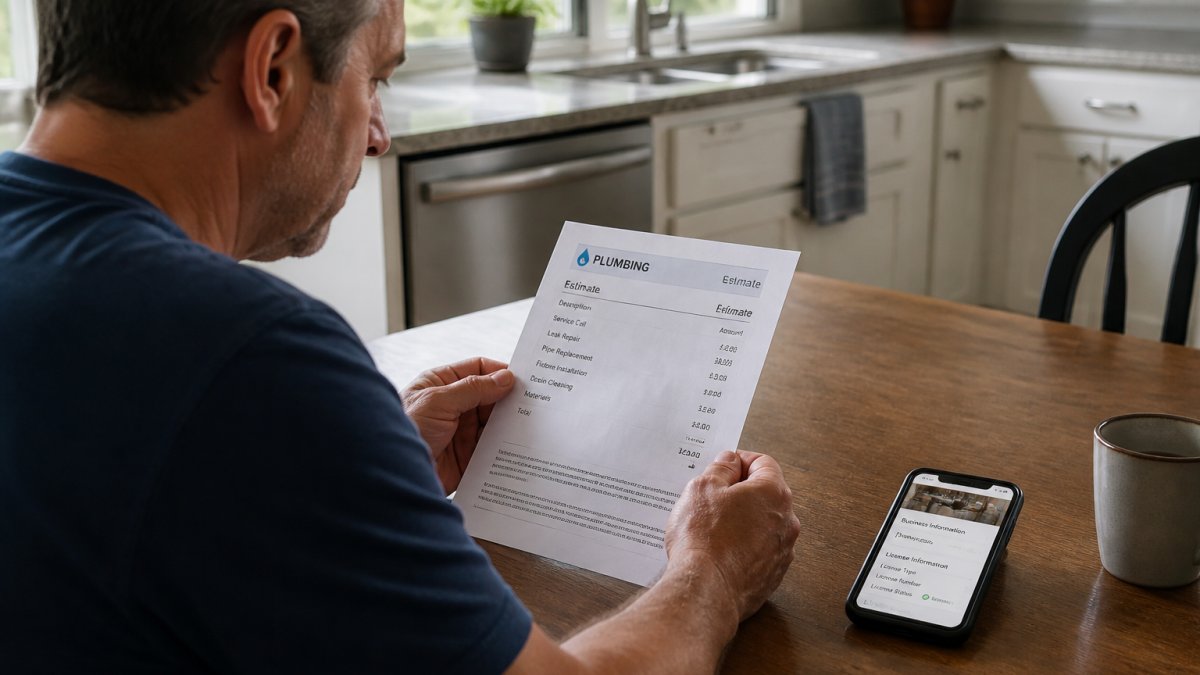
A written estimate is your roadmap and your leverage. It should be detailed enough that you understand exactly what you’re paying for, what’s excluded, and what happens if the job changes. Use the checklist below to compare bids apples to apples.
What a complete written estimate includes
Scope of work. The estimate should describe the specific problem and proposed solution.
Materials, itemized. If the plumber is replacing a water heater, the estimate should list the brand, model, capacity, and whether the manufacturer warranty is included.
Labor, broken down. “Labor: $500” tells you nothing. “Labor: 3 hours at $75/hour for drain snake and clearing” gives you a number you can sanity-check against the scope.
Timeline. Will the job take one visit or three? Is there a start date and a completion date?
Exclusions. This is the line most homeowners never read.
Warranty terms. What happens if the repair fails next week? Get the specific terms in writing: how long the workmanship warranty runs, what it covers, and what voids it.
Call Now For A Free Estimate ?
Payment terms. Do you pay a deposit up front, a balance on completion, or something else? How much is the deposit? What payment methods are accepted?
How to compare two bids side by side
Put the estimates side by side and compare four things: scope, materials, exclusions, and warranty. If one bid is dramatically lower, ask the low bidder to explain their approach in writing. A legitimate difference might be a simpler repair method or shorter warranty; an unexplained difference usually means a corner is being cut somewhere you can’t see.
Ask each plumber to quote the same scope in writing. If you let one bidder define the job differently than another, you’re not comparing prices, you’re comparing two different projects.
Change orders and add-ons
A good estimate includes contingencies, language like “if we find X, it will cost an additional $Y.” What’s not normal is a plumber who starts extra work without your approval. Require them to stop and call you for sign-off before proceeding with anything outside the written scope. This single rule prevents most surprise bills.
Be cautious of unusually large upfront payments. A deposit that covers materials for a scheduled job is one thing; a demand for most of the total before any work begins is a red flag. Tie payments to milestones, deposit, rough-in complete, final inspection, rather than to a calendar.
Turning the estimate into a contract
Once you’ve compared bids and chosen a plumber, the accepted estimate becomes the contract. Before work starts, confirm both you and the plumber have signed it and agree on scope, price, timeline, exclusions, warranty, and payment schedule. Keep a copy, if a dispute arises later, that signed document is what you’ll rely on.
Emergency Plumber Response Time and Availability
When your water heater dies at midnight or a pipe bursts, response time is everything. Every minute water runs into your home is more damage and a higher bill.
Ask the plumber directly: What’s your average response time for emergency calls? Protek Plumbing and Drain Specialists dispatches emergency crews with a target arrival of 60-90 minutes in Port Charlotte and Charlotte County.
Also ask about service hours. Are they available 24/7, or do they charge night and weekend surcharges? Some plumbers charge double or triple rates for off-hours work, common, but you should know the cost before you need the service.
For non-emergencies, ask how far out they book. If you call Monday for a drain cleaning, can they come Wednesday, or is it three weeks out?
Consider setting up a relationship before you need an emergency. Many plumbers offer annual maintenance plans for seasonal residents or property managers. A maintenance visit catches small problems before they become emergencies.
Red Flags and Consumer Protections
Certain behaviors should make you walk away immediately. A plumber who won’t provide a written estimate is hiding something.
Watch for scope creep, the plumber comes to fix a leak and suddenly recommends repiping your entire house. Sometimes that’s legitimate, but get a second opinion before committing to major work.
Be cautious of unusually low bids. If one plumber quotes $800 and another quotes $3,000 for the same job, the low bid likely cuts corners or hides costs.
Protect yourself with a written contract. The estimate becomes the contract, so confirm both you and the plumber have signed it and agree on all terms before work starts.
If the plumber discovers additional work during the job, require them to stop and call you for approval, this prevents surprise bills.
Check your homeowner’s insurance policy to understand what plumbing work is covered and what voids coverage. If a plumber does unpermitted work, your insurer may deny related claims.
Making Your Final Decision
You’ve verified the license, asked the right questions, reviewed the estimate, and checked references. Now decide.
The cheapest option isn’t always the best. When you hire a licensed plumber who arrives promptly and stands behind their work, they’re worth more than someone who takes longer and leaves you with a problem next month. Consider total value: speed, quality, warranty, and professionalism.
Trust your gut. A plumber who is professional, answers clearly, and provides detailed documentation is a good sign. If they’re evasive, pushy, or dismissive, move on.
For homeowners in Port Charlotte and Charlotte County, Protek Plumbing and Drain Specialists combines licensed expertise with responsive service. With over 35 years of experience, we’ve built our reputation on transparent estimates, fast response times, and a 100% workmanship guarantee. When you need a plumber you can trust, that’s what we deliver.
Frequently Asked Questions
How can I verify a plumber’s license in Florida?
Check the Florida Department of Business and Professional Regulation (DBPR) website using their license verification tool. Enter the plumber’s name or license number to confirm active status, any disciplinary actions, and whether they hold the correct classification (journeyman, master, or contractor). Always ask for their license number upfront, legitimate plumbers provide it without hesitation. This step protects you from unlicensed work and ensures the professional meets state standards.
What questions should I ask before hiring a plumber?
Ask about their license and insurance coverage, years of experience with your specific issue, whether they offer a written estimate before starting work, their emergency response time, warranty or guarantee on repairs, and how they charge (hourly rate, flat fee, or per-project). Request references from recent local jobs and clarify what’s included in the service. These questions reveal whether a plumber is transparent, professional, and trustworthy.
How quickly can an emergency plumber respond?
Response time varies by provider and current demand. Many local emergency plumbers aim for arrival within 60-90 minutes for urgent calls like burst pipes or slab leaks. Ask your plumber their typical response window when you call, whether they charge extra for emergency or after-hours service, and if they guarantee a specific arrival time. Knowing this upfront helps you plan and manage expectations during stressful situations.
What should a plumbing estimate include?
A complete estimate lists the specific problem, proposed solution, labor costs, materials needed with brand names, timeline for completion, warranty details, and total price. It should be in writing and itemized so you understand what you’re paying for. Compare estimates from multiple licensed plumbers side by side, significant price differences may indicate different scopes of work. Always get clarification before signing if anything is unclear or seems incomplete.
Hiring a licensed plumber protects your home and your wallet. The time you spend verifying credentials, asking questions, and reviewing estimates upfront saves you thousands in mistakes and rework. When you’re ready to move forward with a professional you trust, Protek Plumbing and Drain Specialists is here to help. Call now for a free estimate and see why hundreds of local homeowners rely on us for everything from emergency repairs to complete repiping solutions.