
Last Updated: November 19, 2026
Quick Summary
A tankless water heater is worth it for Florida homes when you have gas service, moderate simultaneous hot-water demand, and plan to stay long enough to recover the higher installed cost. Mild incoming groundwater means units work less to reach your set point, but panel or gas-line upgrades can stretch payback.
- Storage tanks keep 40 to 80 gallons hot around the clock; tankless units heat water on demand with no standby heat loss.
- In much of Florida, groundwater runs in the low-to-mid 70s°F, so a 120°F set point often needs only a 45°F to 50°F rise.
- Two showers plus a dishwasher demand roughly 5.5 to 6.5 GPM, so size units at your actual temperature rise.
- Descale your tankless unit once a year in hard-water areas to protect the heat exchanger and efficiency.
- Gas tankless units need electricity to ignite, so a power outage can leave you without hot water despite gas in the line.
Table of Contents
- Tank vs. Tankless Water Heater: How the Two Systems Differ
- Tankless Water Heater Cost in Florida: What Drives the Price
- Tankless Water Heater Pros and Cons for Florida Households
- Sizing a Tankless System for Florida Water Temperatures and Peak Demand
- Tankless Water Heater Maintenance in Hard-Water Areas
- Payback Period and Long-Term Value: Running the Numbers
- Hurricane Season, Power Outages, and Hot-Water Backup
- Getting a Transparent Tankless Quote for Your Home
- Frequently Asked Questions
Tank vs. Tankless Water Heater: How the Two Systems Differ
Whether a tankless water heater is worth it for Florida homes comes down to how you use hot water, what your utility setup looks like, and how long you plan to stay. The answer depends on your household’s hot-water use and utility setup, and it is rarely the same for any two homes.
A storage tank water heater keeps 40 to 80 gallons hot around the clock, which means it pays to reheat water even when nobody is home. A tankless unit heats water on demand as it flows through the exchanger, so there is no standby heat loss and no tank to run out mid-shower. The trade-off is a higher upfront cost and a retrofit that often touches your electrical panel or gas line.
| Feature | Storage Tank | Tankless |
|---|---|---|
| Hot water supply | Limited to tank size | Continuous, on demand |
| Standby heat loss | Yes, ongoing | None |
| Upfront cost | Lower | Higher |
| Lifespan | Shorter | Longer with maintenance |
| Space needed | Closet or garage footprint | Wall-mounted, compact |
| Peak simultaneous demand | Shared tank capacity | Limited by flow rate |
If you are still weighing which style fits your household, our guide on choosing the right water heater breaks down the decision by family size and usage.
Tankless Water Heater Cost in Florida: What Drives the Price
Tankless water heater cost in Florida is driven less by the unit itself than by what has to change behind the wall. A straightforward swap in a home with an oversized electrical panel or an existing gas line costs far less than a retrofit that requires new circuits, a larger gas supply, or relocated venting.
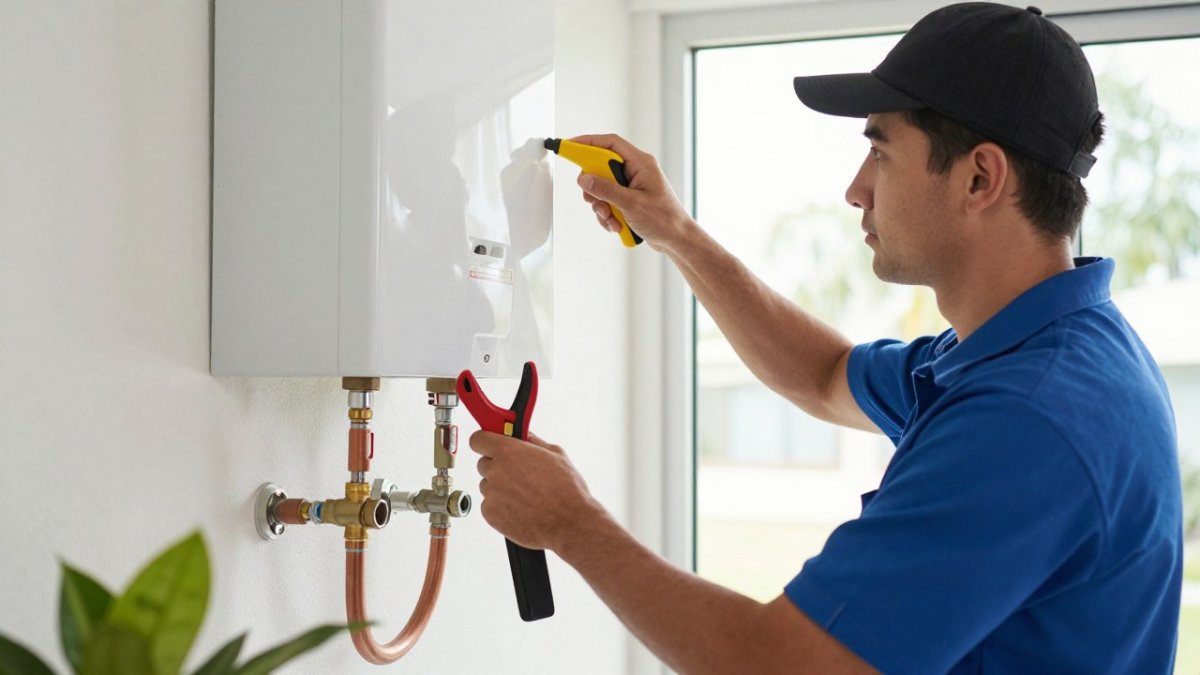
Three factors move the number most:
- Fuel type. Electric tankless units draw heavy amperage and may need a panel upgrade. Gas units need adequate line capacity and proper venting.
- Location. Moving the unit closer to fixtures shortens pipe runs but adds labor.
- Home age. Older homes often need wiring, gas, or venting brought up to current code before the unit goes in.
Electrical Panel and Gas-Line Upgrades
Electric tankless heaters pull significant current, and many older panels cannot carry the added load without an upgrade. Gas units face a similar hurdle: undersized supply lines can starve the burner and cut performance. A load calculation and gas-line sizing check are part of a thorough quote.
Venting, Permits, and Retrofit Complexity
Venting requirements depend on the unit and its location, and permits are handled at the local level, so requirements vary by jurisdiction. Ask your contractor which permits apply to your address before signing anything. Retrofit complexity is the single biggest wildcard in any tankless quote.
Tankless Water Heater Pros and Cons for Florida Households
Tankless water heater pros and cons look different in Florida than in colder states. Mild incoming water temperatures mean the unit works less to reach your set point, and compact wall-mounted units can free up closet space.
The downsides are real, though. Higher upfront cost, maintenance that cannot be skipped in hard-water areas, and a flow rate ceiling that punishes simultaneous use all matter. If you are weighing the risks, understanding common problems like a leaking water heater helps you plan for the repair side of ownership.
Best for: households with gas service, moderate simultaneous demand, and a long-term stay.
Skip if: you are in a older home with a maxed-out panel and no gas line, or you plan to sell within a few years.
Sizing a Tankless System for Florida Water Temperatures and Peak Demand
Sizing is where most tankless disappointments begin, and it is the one calculation every Florida homeowner should run before signing a quote. Two numbers decide whether a unit will keep up: the temperature rise it must produce and the peak flow rate your household demands at the same time.
Temperature rise. Tankless units are rated by flow rate at a specific temperature rise, commonly expressed in gallons per minute (GPM) at a 35°F, 45°F, or 77°F rise. The rise is simply your target hot-water temperature minus the incoming groundwater temperature.
Peak demand. Add the flow rates of every fixture likely to run at once. Typical published fixture flow rates are roughly:
- Standard showerhead: about 2.0-2.5 GPM
- Kitchen faucet: about 1.5-2.2 GPM
- Dishwasher: about 1.0-1.5 GPM
- Washing machine: about 1.5-2.5 GPM
- Bathroom faucet: about 1.0-1.5 GPM
A household running two showers plus a dishwasher at the same time is asking for roughly 5.5-6.5 GPM. Add laundry and you are near 8 GPM. That is the number the unit must satisfy at your actual temperature rise, not the number on the showroom tag.
Three practical household examples.
- One-bath condo, two occupants. Peak demand is usually a single shower plus a bathroom faucet, about 3.0-3.5 GPM. A modest electric unit or a small gas unit sized at that flow and a 45°F rise is often enough; the constraint is usually the electrical panel, not the GPM.
- Three-bedroom, two-bath home, four occupants. Morning overlap of two showers plus a kitchen faucet lands near 5.5-6.5 GPM. A gas unit rated for that flow at a 45°F rise is the common target; an electric unit at that flow typically needs a large service and may still struggle.
- Four-bedroom home with a soaking tub and laundry. A tub fill alone can draw 4-6 GPM, and overlapping laundry pushes peak demand toward 8-10 GPM. This is where whole-house gas units or a condensing model with a buffer tank earn their price.
Where sizing goes wrong. Watch out: sizing to the headline GPM instead of the GPM at your actual temperature rise is the most common error, and it produces the classic complaint, cold water the moment a second fixture opens.
What to bring to a quote. Have the contractor perform a load calculation using your fixture count, occupant count, and the incoming water temperature for your area, and ask them to show the unit’s rated GPM at your specific rise. If they cannot produce that number, the sizing is a guess.
Typical fixture flow rates in gallons per minute
Tankless Water Heater Maintenance in Hard-Water Areas
Tankless water heater maintenance is not optional in hard-water areas. Mineral buildup scales the heat exchanger, cutting efficiency and eventually causing failures that cost far more than annual service.
Descaling once a year is the standard recommendation for most hard-water homes. Skipping it is the most common mistake we see, and it quietly shortens the unit’s life. If scale or repairs become routine, local water heater repair service can restore performance before replacement is needed.
Payback Period and Long-Term Value: Running the Numbers
Payback is not a slogan; it is arithmetic with assumptions you can check.
The formula. Payback in months = installed tankless premium ÷ monthly energy savings. Installed premium means the full difference in installed cost, unit, labor, panel or gas work, venting, permits, and disposal, not the sticker price difference.
A worked example with stated assumptions. Suppose the household spends about $40 per month heating water with the storage tank, and the tankless unit’s higher efficiency cuts that by roughly 20%, about $8 per month.
What moves the number most.
- The installed premium.
- Utility rates. Electric and natural gas rates differ by utility and season, and savings depend on the rate you pay.
- Household hot-water use. Low-use households see small dollar savings even at high efficiency percentages, which stretches payback.
- Service life. Tankless units generally have a longer expected service life than storage tanks when maintained, but only if the unit is descaled on schedule. A neglected unit in a hard-water area can erase the lifespan advantage.
The comparison most guides skip. Run the same arithmetic for a high-efficiency storage tank. A condensing storage unit costs less to install than tankless and captures much of the efficiency gain, so its payback is often shorter even though its service life is shorter.
When the numbers favor tankless. Payback math favors tankless when the installed premium is modest (existing gas line, adequate panel), hot-water use is high, utility rates are high, and you plan to stay well past the payback point.
If you are ready to compare real numbers for your home, you can request a new water heater installation, and you can read reviews from local customers before you commit.
Hurricane Season, Power Outages, and Hot-Water Backup
Storm season adds a factor most buying guides ignore. Gas tankless units need electricity to ignite and control flow, so a power outage can leave you without hot water even with gas in the line. Storage tanks hold a reserve of hot water that survives a short outage.
If backup hot water matters to you, ask about outage behavior before you buy.
Getting a Transparent Tankless Quote for Your Home
A fair quote itemizes the unit, labor, panel or gas work, venting, permits, and disposal. Anything vague deserves a question. If you are ready to move forward, you can request a new water heater installation, and you can read reviews from local customers before you commit.
The real question is not whether tankless is trendy, but whether it fits your home’s wiring, gas supply, and water use. Protek Plumbing and Drain Specialists has served this area for over 35 years, with transparent estimates before work begins, a 100% workmanship guarantee, and 24-hour emergency service when something fails. Get started with Protek Plumbing and Drain Specialists and get a straight answer on whether tankless makes sense for your home.
Frequently Asked Questions
Why don’t some plumbers recommend tankless water heaters?
The hesitation usually comes down to installation complexity and service calls. Tankless units often need electrical panel or gas-line upgrades, and in hard-water areas they require annual descaling to keep the heat exchanger working. A plumber who mostly installs storage-tank systems may also be less familiar with sizing on-demand units for peak simultaneous demand. None of that makes tankless a bad choice; it means the installer needs to calculate flow rate and temperature rise correctly and explain the maintenance schedule up front.
Are electric tankless water heaters a good choice for Florida homes?
They can be, but the electrical service is the deciding factor. Electric tankless units draw a large current during operation, and many older homes need a panel upgrade or dedicated circuits before one can be installed. Florida’s warm incoming water temperature helps here, because a smaller temperature rise means the unit needs less power to deliver a given flow rate. Have a licensed plumber check your panel capacity and whole-house demand before committing to an electric model.
Do tankless water heaters need regular maintenance?
Yes. The most common task is descaling the heat exchanger to remove mineral buildup, which matters in areas with hard water. Skipping it reduces efficiency and shortens the unit’s life. Most manufacturers recommend an annual flush, and some warranty terms depend on documented maintenance. Budget for that service as part of your operating cost, and ask your plumber whether a water softener or filtration system would reduce how often descaling is needed.
How long does a tankless water heater last compared with a storage tank?
Tankless units generally have a longer expected service life than storage-tank models, largely because there is no tank to corrode or leak. Actual lifespan depends on water quality, maintenance, and installation quality. In hard-water areas, skipped descaling is the biggest factor that shortens life. Ask your installer for the manufacturer’s expected lifespan and warranty terms for the specific model, and factor replacement timing into any payback calculation you run.
