
Last Updated: November 15, 2026
Quick Summary
Prevent tree roots from damaging sewer lines by installing physical root barriers between trees and pipes, planting trees at a distance from the lateral roughly equal to their mature height, and choosing non-invasive species that stay under 20 feet at maturity near a sewer line. Because vulnerability depends on pipe material, clay and cast iron laterals near mature trees warrant a camera inspection sooner, and relining seals the joints and cracks roots exploit.
- Tree roots enter sewer pipes at the weakest points: joints, cracks, and seams between pipe sections.
- Multiple slow drains throughout the house point to a main line problem rather than a single clog.
- No product truly dissolves tree roots; chemical root killers leave dead root mass that still needs removal.
- Call 811 before you dig to mark underground utilities; it is free and prevents costly damage.
- Clay tile is the most root-prone lateral material because roots exploit hairline gaps at its joints.
Table of Contents
- Why Tree Roots Target Your Sewer Lateral
- Symptoms of Tree Roots in Sewer Line You Should Not Ignore
- What Dissolves Tree Roots in Sewer Lines: Chemical and Foaming Options
- How to Remove Tree Roots from Sewer Line Permanently
- Roots in Pipes Removal Cost: DIY vs. Professional
- Preventative Measures: Barriers, Planting Distances, and Pipe Material
- Schedule a Sewer Camera Inspection to Protect Your Pipes
- Frequently Asked Questions
Why Tree Roots Target Your Sewer Lateral
Tree roots invade sewer lines because your pipes carry water, nutrients, and oxygen, which roots need to survive. A sewer lateral is the pipe running from your home to the main city sewer, and it is the most common invasion point on any property. This problem is common in older neighborhoods with mature trees.
Roots do not “seek out” pipes by magic. They grow toward moisture. A tiny leak or a loose joint is enough to pull them in.
How Roots Enter Through Pipe Joints
Roots enter at the weakest points: the joints, cracks, and seams where one pipe section meets another. Clay pipes and old cast iron are especially vulnerable. Their joints loosen over time, and even a hairline gap lets in water vapor.
Once a root finds that gap, it grows inside the pipe. The root mass expands, catches grease and waste, and starts a blockage. Over time, pressure from growing roots can fracture the pipe entirely.
Roots do not stop at the first blockage. They keep growing toward the flow, so a small intrusion can grow into a serious backup over time.
Symptoms of Tree Roots in Sewer Line You Should Not Ignore
The most common signs of root intrusion are slow drains throughout the house, gurgling toilets, and sewage smells in the yard. Multiple slow drains at once point to a main line problem, not a single clog.
Other symptoms to watch for:
- Water backing up in floor drains or the tub when you run the washer
- Soggy, sunken patches of grass over the sewer path
- Extra-green strips of lawn above the pipe
- Repeated clogs in the same spot
- A sewer smell inside or outside the home
If you notice these signs, a blocked sewer drain may already be forming. Catching it early keeps a small root problem from turning into a pipe replacement. A clogged sewer line service can confirm and clear the blockage before it backs up into your home.
What Dissolves Tree Roots in Sewer Lines: Chemical and Foaming Options
No product truly dissolves tree roots. Chemical root killers and foaming agents kill roots and slow regrowth, but the dead root mass stays in the pipe and still needs removal. That is the part most guides skip, and it is why a chemical treatment alone rarely clears a blockage.
There are two broad categories: contact herbicides that kill roots on contact, and growth-inhibiting foams that leave a residue on the pipe wall to stop new root tips from pushing back in. Neither repairs a cracked pipe, and neither removes the root mass already inside.
Copper Sulfate and Dichlobenil: What They Do and Do Not Fix
Copper sulfate is a contact root killer. It is usually applied through a cleanout, often as crystals flushed with water, and it kills roots it reaches. It does not travel far into a dense root mass, and it is toxic to aquatic life, so it should never be flushed into a line that drains to a storm system or a waterway.
What neither product fixes:
- Dead roots already inside the pipe, which still catch grease and waste
- Cracked, offset, or fractured pipe sections
- Root masses thick enough to have already reduced flow
Watch out: pouring a root killer down a drain and assuming the job is done is the most common mistake. The roots die, the blockage remains, and the dead mass can make the next clog worse.
Application, Safety, and Local Rules
Both products are applied through a cleanout, not a floor drain or toilet, so the chemical reaches the lateral rather than sitting in a trap. Read the label for dilution and dwell time; over-application does not work faster and increases the risk to nearby plants.
Check your state’s pesticide rules and any local sewer-use ordinance before applying either product, and never use them if you have a septic system or a line that discharges to a waterway.
Eco-Friendly Alternatives and When Chemicals Are the Wrong Tool
If you want to avoid harsh herbicides, the practical options are mechanical and physical rather than chemical:
- Mechanical cutting (snaking or hydro-jetting) removes roots without introducing a herbicide into the line.
- Foaming root inhibitors based on non-herbicidal surfactants can slow regrowth in some products, though they are less proven than dichlobenil.
- Physical barriers and smart planting prevent the problem instead of treating it.
- Pipe relining seals the entry point permanently, which removes the need for recurring chemical treatments.
A common pattern is to use a chemical inhibitor as seasonal maintenance only after the pipe has been mechanically cleared and inspected. If the pipe is cracked or offset, chemicals are the wrong tool entirely; the fix is structural.
How to Remove Tree Roots from Sewer Line Permanently
Permanent root removal means cutting the roots out and then fixing the entry point. Cutting alone only buys time. Roots grow back toward the same moisture source.
The proven methods:
- Mechanical snaking cuts roots from inside the pipe.
- Hydro-jetting uses high-pressure water to scour roots and debris from the pipe walls.
- Sewer camera inspection locates the exact entry points.
- Pipe relining or trenchless repair seals cracks and joints so roots cannot return.
A sewer cleaning plumber can clear the roots safely and confirm the pipe is sound. Hydro-jetting uses high-pressure water to clean roots and debris from the pipe walls.
Roots in Pipes Removal Cost: DIY vs. Professional
DIY root removal looks cheaper up front, but it rarely solves the problem.
The real cost comparison comes down to risk:
- DIY: low upfront cost, high risk of damaged pipes, recurring clogs, and no way to see the actual damage
- Professional: higher upfront cost, but you get root cutting, camera verification, and a fix for the entry point
If you are facing an active backup, do not wait. An emergency plumber can stop the mess and assess the damage before it spreads.
Preventative Measures: Barriers, Planting Distances, and Pipe Material
Prevention is cheaper than repair, and it starts before you plant anything. Three levers matter most: physical barriers, smart planting, and the right pipe material. Most guides cover the first two and skip the third, which is the one that determines how vulnerable your lateral actually is.
Physical Root Barriers and Geotextile Fabric
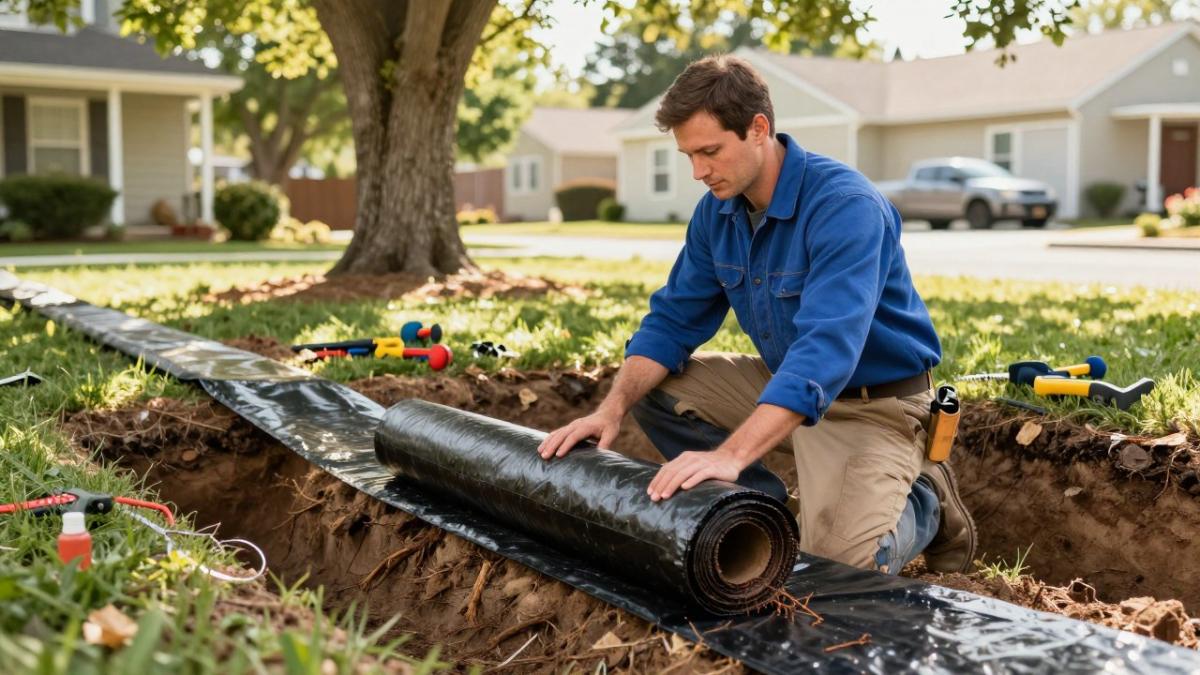
A root barrier is a physical shield, usually a heavy plastic or geotextile fabric panel, installed vertically between a tree and the pipe. It forces roots to grow down or around instead of into the sewer.
Install barriers when you plant, or during a sewer repair when the trench is already open. Geotextile fabric works well for lighter root systems. Rigid panels last longer against aggressive trees. The barrier should extend from just above grade to below the depth of the pipe, and it should run the length of the root zone, not just a short strip near the trunk.
Safe Planting Distances and Non-Invasive Species
Keep trees with invasive root systems well away from the lateral. A common guideline is to plant trees at a distance from the pipe roughly equal to their mature height. Large shade trees need the most distance.
Choose species with slower, deeper root growth:
- Smaller ornamental trees and most shrubs
- Species known for non-invasive roots
- Anything that stays under 20 feet at maturity near a sewer line
Before you dig, call 811 to mark underground utilities (811 Before You Dig). It is free and prevents costly damage.
Pipe Material Compatibility: Why Clay and PVC Fail Differently
This is the part most prevention guides miss. Root vulnerability depends heavily on what the lateral is made of.
- Clay tile is jointed in short sections. The joints are the weak point, and roots exploit hairline gaps at the seams. Clay is common in older neighborhoods and is the most root-prone material.
- Cast iron is jointed and corrodes over decades. Roots enter at deteriorated joints and at rust-through points.
- Orangeburg (bituminized fiber) is an obsolete material that deforms and collapses; roots enter almost anywhere along it.
- PVC is joined by solvent cement or gaskets and has fewer joints, so it is far more root-resistant, but a poor glue joint or a shifted gasket still lets roots in.
- Concrete is jointed and cracks over time; roots follow the cracks.
A common pattern is a clay lateral under a mature tree, where the joints have loosened and roots have entered at multiple seams. If you know your pipe material, you can prioritize: clay and cast iron laterals near mature trees warrant a camera inspection sooner, while a sound PVC lateral is lower risk.
Matching Prevention to Your Pipe
If the lateral is clay or cast iron and a mature tree sits within the root zone, the highest-value prevention is a camera inspection plus a barrier or relining during any repair. If the lateral is PVC and sound, smart planting and distance are usually enough. Relining seals joints and cracks from the inside, which removes the entry points roots exploit, and it is often cheaper than excavation when the pipe is still structurally sound.
Root vulnerability depends heavily on what your lateral is made of, so match prevention to the pipe material.
| Pipe material | Weak point for roots | Note |
|---|---|---|
| Clay tile | Hairline gaps at joints between short sections | Most root-prone material; common in older neighborhoods |
| Cast iron | Deteriorated joints and rust-through points | Jointed and corrodes over decades |
| Orangeburg | Almost anywhere along the pipe | Obsolete material that deforms and collapses |
| PVC | Poor glue joint or shifted gasket | Fewer joints, far more root-resistant |
| Concrete | Cracks over time | Jointed; roots follow the cracks |
Schedule a Sewer Camera Inspection to Protect Your Pipes
A sewer camera inspection is a direct way to see inside the pipe and confirm what is happening.
U.S. Environmental Protection Agency guidance on private sewer laterals notes that homeowners are typically responsible for the lateral on their property, which makes early inspection worth the effort.
We can inspect inside your sewer line with a sewer line camera and show you exactly where roots are entering.
Tree roots will always find moisture. The question is whether you catch the intrusion before it fractures a pipe or floods your yard.
Frequently Asked Questions
How common are tree roots in a sewer line?
Root intrusion is one of the most frequent causes of sewer line blockages, especially in older neighborhoods with clay pipes and mature trees. Roots seek moisture and nutrients, and a sewer lateral provides both. Any home with large trees within 10 to 20 feet of the line is at risk, and the problem often goes unnoticed until a backup occurs.
Does homeowners insurance cover tree root damage to sewer lines?
Coverage for tree root damage depends on your specific policy. Review your policy or ask your agent before assuming you are covered.
What dissolves tree roots in sewer lines naturally?
Root killers are sometimes used to address root growth in sewer lines, but they do not remove dead root mass. For severe intrusion, professional mechanical removal is a common approach.
Can you prevent tree roots from damaging an existing sewer pipe?
Yes. Physical root barriers, safe planting distances, and periodic sewer camera inspections can help reduce the risk of root damage. Trenchless pipe relining may also be considered to seal joints that roots can exploit. Protek Plumbing and Drain Specialists can scope your line and recommend the right preventative step for your property.
