
Last Updated: November 14, 2026
Quick Summary
Whole house repiping is usually worth it for a 40-year-old home when the inspection shows galvanized steel at or past its service life, or a pattern of recurring leaks, rusty water, and falling pressure. Copper in good condition may not need it, so material and inspected condition decide, not age alone.
- Galvanized steel at 40 years is usually a yes for repiping; copper in good condition may not be.
- Three repairs in two years or a second leak in the same wall points to a system-wide problem.
- Repiping a house cost depends on square footage, pipe material, fixture tie-ins, and line accessibility.
- Most homeowner policies cover sudden water damage but exclude long-term leakage, corrosion, and wear-and-tear.
- Confirm the permit was pulled and the inspection signed off before final payment.
Table of Contents
- Why a 40-Year-Old Home Reaches a Plumbing Decision Point
- 7 Signs Your 40-Year-Old Home Needs Whole House Repiping
- Repiping a House Cost: What Drives the Price
- Should I Repipe My House With PEX?
- What to Expect When Repiping a House
- How Long Does Repiping a House Last?
- Inspection, Insurance, Permits, and Resale Value
- Schedule a Repiping Inspection for Your 40-Year-Old Home
- Frequently Asked Questions
Why a 40-Year-Old Home Reaches a Plumbing Decision Point
If your house was built in the mid-1980s, its original pipes are now roughly four decades old. That matters because whole house repiping decisions almost always land at this exact age. Homes in this age bracket commonly reach the point where repairs start stacking up after decades of trouble-free service.
A 40-year-old home sits at a genuine fork in the road. Some systems have years left. Others are one cold snap away from a flooded hallway. The difference usually comes down to pipe material, water chemistry, and how the system was installed.
Pipe Age and Expected Lifespan by Material
Pipe lifespan depends on material more than anything else. Pipe lifespan depends heavily on material and water chemistry, and an inspection is the most reliable way to judge the condition of a specific system.
That means a 1980s home with original galvanized steel is at or past its expected service life. Copper from the same era may still have runway, but only if the water hasn’t eaten through it.
Common Problems With Older Plumbing
Older plumbing fails from the inside out. Rust flakes, mineral scale, and sediment collect on pipe walls until flow drops and joints weaken. Hidden problems in vintage walls are covered in more depth in our guide to old plumbing problems in historic homes, and the short version is this: by year 40, most failures are cumulative, not sudden.
7 Signs Your 40-Year-Old Home Needs Whole House Repiping
The clearest sign is a pattern, not a single event. One repair is normal. Three repairs in two years, or a second leak in the same wall, points to a system-wide problem. Below are the seven signals we look for during an inspection. For the full whole house repiping service, see what the project involves and how to book it.
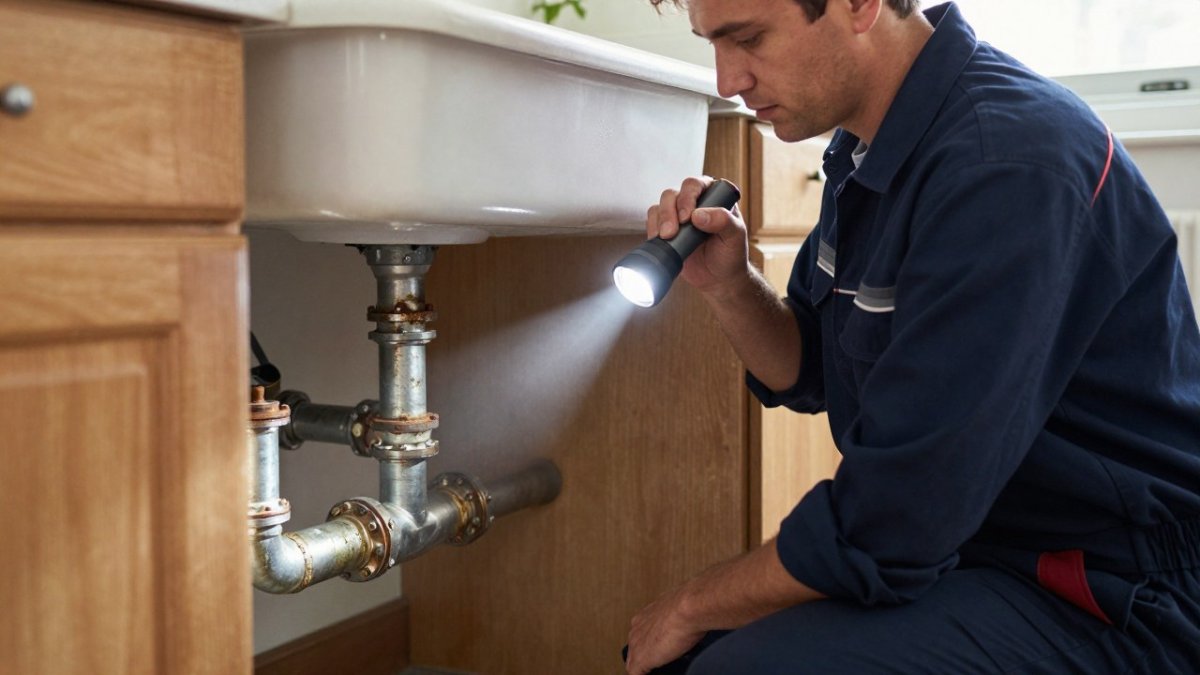
- Recurring leaks in different parts of the house
- Rusty or brown water, especially after vacation or first draw
- Low or inconsistent water pressure at multiple fixtures
- Discolored water that clears after running
- A slab leak or unexplained spike in the water bill
- Visible corrosion on exposed pipes in the garage or utility room
- Frequent repairs totaling more than a repipe would cost
Corrosion, Rust, and Mineral Buildup
Corrosion is the slow destruction of pipe metal by water chemistry. Rust-colored water at the tap means the pipe interior is already compromised. Mineral buildup narrows the pipe bore, which is why pressure fades before leaks appear.
Frequent Leaks, Slab Leaks, and Recurring Repairs
A slab leak is a leak beneath your foundation, and it is one of the strongest arguments for repiping. If you suspect one, our slab leak warning signs guide walks through what to look for, and slab leak detection and repair explains how professionals locate the leak without tearing up the whole floor.
Low Water Pressure and Discolored Water
Pressure loss at every fixture usually means the supply lines are scaled shut. Brown water after a shutoff is rust and sediment stirred loose. Neither improves on its own.
Repiping a House Cost: What Drives the Price
Repiping a house cost depends on square footage, pipe material, how many fixtures need tying in, and how accessible the lines are. Access is often a major factor, since opening and restoring finished walls, ceilings, and floors can account for a large share of the total.
The other drivers worth pricing out before you commit:
- Pipe material. Material choice affects both cost and installation time, so ask for a comparison based on your home.
- Fixture count and tie-ins. Each sink, toilet, tub, and appliance connection is a tie-in. A three-bath home with a kitchen, laundry, and hose bibs is more work than a one-bath ranch.
- Access and restoration. Patching drywall, texture, and paint is often a separate line item from the plumbing itself. Ask whether restoration is included or subcontracted.
- Permits and inspection. Permit fees and inspection scheduling vary by jurisdiction and add both cost and calendar time.
- Water shutoff and temporary service. Multi-day projects may require the crew to restore water each evening; confirm this is in the scope.
We give transparent estimates before work begins, so you know the scope before anyone opens a wall. For a closer look at why replacement beats patching, see why a repipe may be the right call.
Repair vs. Repipe: A Transparent Comparison
The upfront number alone is an incomplete comparison. Looking at the total cost of ownership over the coming years, including repeat repairs and possible water damage, gives a clearer picture.
| Factor | Spot Repair | Whole-House Repipe |
|---|---|---|
| Upfront cost | Lower per visit | Higher one-time |
| Solves the root cause | No, addresses one failure point | Yes, replaces the system |
| Repeat visits likely | Yes, and frequency tends to rise | Rare |
| Water damage risk | Remains on every remaining pipe | Largely removed on replaced lines |
| Water pressure restored | Partially, at the repaired fixture | Fully, across all fixtures |
| Disruption | Hours | Multi-day |
| Hidden cost | Drywall and flooring repair per leak; possible insurance deductible | One restoration pass |
| Best for | One isolated failure in otherwise healthy pipe | System-wide failure or material past service life |
A common pattern in 40-year-old homes: the first two repairs feel manageable, then the third and fourth arrive within a year or two of each other, and the homeowner has spent a meaningful fraction of a repipe without fixing the underlying problem. The break-even point is not a single number, it depends on your material, water chemistry, and how many repairs you have already absorbed, but the direction is consistent: repeated repairs on failing pipe rarely get cheaper.
Watch out: a low bid that excludes drywall repair, permit fees, or fixture tie-ins can end up costing more than a complete quote. Ask for a line-item scope, not a single lump sum.
Should I Repipe My House With PEX?
PEX is a common modern option for supply lines, and your plumber can explain whether it suits your home’s layout and water conditions.
PEX vs. Copper: Material Comparison
| Feature | PEX | Copper |
|---|---|---|
| Corrosion resistance | High | Moderate |
| Joint count | Low | High |
| Installation disruption | Lower | Higher |
| Lifespan | Decades | Decades, water-dependent |
| Best for | Most repipes | Specific code or preference cases |
Copper still has a place, particularly where local code or homeowner preference calls for it.
What to Expect When Repiping a House
Repiping projects are typically multi-day and involve water shutoffs while work is underway. Your plumber can walk you through the expected schedule and access requirements before work begins.
How Long Does Repiping a House Last?
How long repiping a house lasts depends on material and water quality. PEX and copper both deliver decades of service when installed correctly. Workmanship matters as much as the pipe itself, and our 100% workmanship guarantee applies to the work we perform.
Inspection, Insurance, Permits, and Resale Value
Before you commit to a repipe, confirm what you actually have. Age alone does not decide it; material and inspected condition do. A practical inspection for a 40-year-old home should answer five questions:
- What material are the supply lines? Galvanized steel, copper, PEX, and CPVC age very differently. A plumber should identify the material at the main, at a few fixtures, and in the attic or crawlspace.
- What is the interior condition? Look for corrosion at joints, pinholes, green or white crust on copper, and rust flakes in aerators or toilet tanks.
- How is pressure across the system? A pressure reading at multiple fixtures shows whether the problem is system-wide or isolated.
- Is there evidence of prior leaks? Water staining, soft drywall, and repaired patches tell you how the system has been failing.
- What is the water chemistry? Hard or aggressive water shortens copper life; a water test is cheap insurance against a wrong recommendation.
Ask the plumber to show you what they found, not just tell you. Photos of corroded joints and a written summary of material and condition make the recommendation auditable.
Insurance. Most homeowner policies cover sudden, accidental water damage but exclude or limit damage from long-term leakage, corrosion, and wear-and-tear.
Permits and inspection. Repiping generally requires a permit, and the work is inspected to confirm it meets the adopted plumbing code. Permit requirements and fees vary by jurisdiction, so confirm locally before work starts.
Warranty. Distinguish the workmanship warranty from the manufacturer’s product warranty. Workmanship coverage is only as good as the contractor’s longevity, so ask how long the workmanship guarantee runs and whether it transfers to a new owner.
Resale and disclosure. Documented repiping is a selling point: buyers and inspectors treat updated supply lines as reduced risk, and a permit record plus photos of the work before walls closed is strong evidence.
Confirm that any permit was pulled and the inspection signed off before final payment, since unpermitted work can complicate a sale.
Schedule a Repiping Inspection for Your 40-Year-Old Home
The honest answer to whether whole house repiping is worth it for a 40-year-old home is that it depends on what the inspection finds. Galvanized steel at 40 years is usually a yes. Copper in good condition may not be.
At Protek Plumbing and Drain Specialists, we bring over 35 years of experience to that decision. Our licensed, bonded, and insured team provides transparent estimates before work begins, 24-hour emergency service if a pipe fails tonight, and a 100% workmanship guarantee on every repipe. We’ll inspect your system and tell you plainly whether you need a repair or a repipe.
A failing plumbing system rarely gives you a convenient warning. Get ahead of it with an inspection from Protek Plumbing and Drain Specialists, where you get upfront pricing, licensed professionals, and a workmanship guarantee that stands behind the job. Get started with Protek Plumbing and Drain Specialists and know exactly where your pipes stand.
Frequently Asked Questions
How much does it cost to repipe a 4,000-square-foot house?
Repiping a 4,000-square-foot home typically involves more pipe runs, fixtures, and labor hours than a smaller house. The final number depends on pipe material, how accessible the lines are, whether drywall repair is needed, and local permit fees. Protek Plumbing and Drain Specialists provides transparent estimates before work begins, so you get a firm scope and price rather than a guess. Call for a free estimate based on your home’s layout and pipe condition.
Is it better to repair a leak or repipe the whole house?
A single isolated leak on otherwise sound copper can justify a spot repair. But when a 40-year-old home has had three or more leaks in a few years, or the pipes are galvanized steel with heavy corrosion, repairs just move the problem down the line. Whole house repiping replaces the failing system in one project rather than a series of separate repairs. An inspection tells you which side of that line your home is on.
Does repiping a house increase its value?
New water supply lines can be a selling point. Buyers and inspectors often look closely at galvanized steel and aging copper, and documented work with permits can help during negotiations. The boost is not a fixed dollar figure, but updated plumbing supports resale value and can make a 40-year-old home easier to sell.
What should homeowners expect during a whole-house repipe?
Repiping projects commonly involve water shutoffs during parts of the workday, drywall openings where pipes run behind walls, and work spread over several days. Plan for limited water use during work hours, and ask your plumber to review the expected schedule and access points before work begins.
