
Last Updated: November 12, 2026
Quick Summary
Slab leak repair offers four legitimate options: direct access, tunneling, pipe rerouting, and trenchless repair. Direct access breaks through the concrete for isolated shallow leaks, tunneling preserves finished floors, rerouting bypasses chronically failing lines, and trenchless lining rehabilitates sound host pipes without excavation. Detection always comes first, because the leak location and pipe material determine which method fits.
- Direct access repair means jackhammering the slab, replacing the damaged pipe section, and patching the floor afterward.
- Under-slab tunneling creates a small access pit outside the foundation to reach pipes without touching flooring.
- Pipe rerouting abandons the damaged line and runs a new bypass through the attic, walls, or ceiling.
- Trenchless lining requires a structurally sound host pipe and consumes roughly a quarter to a third of internal diameter.
- Published cost guides put detection at roughly $150 to $600 and rerouting or repiping at $1,500 to $15,000.
Table of Contents
- Slab Leak Repair Options for Concrete Foundations: A Side-by-Side Comparison
- How Plumbers Detect Slab Leaks Before Choosing a Repair
- Direct Access Repair: Breaking Through the Concrete Slab
- Tunneling Beneath the Foundation: Repair Without Breaking the Floor
- Pipe Rerouting for Slab Leaks: When Bypassing the Damaged Line Wins
- Trenchless Repair: Pipe Lining and Epoxy Coating Without Excavation
- Slab Leak Repair Cost: What Drives the Price of Each Method
- Does Homeowners Insurance Cover Slab Leak Repair?
- Frequently Asked Questions
Slab Leak Repair Options for Concrete Foundations: A Side-by-Side Comparison
A slab leak repair is one of the most consequential plumbing decisions a homeowner faces, because the wrong method can mean paying twice. At Protek Plumbing and Drain Specialists, we have over 35 years of experience, and we can tell you plainly: four legitimate repair options exist, and each one fits a different situation. Below, we compare direct access, tunneling, pipe rerouting, and trenchless repair on cost, disruption, and durability so you can choose with your eyes open.
How to Use This Comparison
Start with the leak location and pipe material, then match them to a method. A single failed copper line under a bathroom floor points one direction. A failing system across an entire slab points another.
| Method | Best For | Disruption | Relative Cost |
|---|---|---|---|
| Direct access | Isolated leak, shallow pipe | High, floor opened | Lower |
| Tunneling | Interior finished floors | Low at surface | Higher |
| Pipe rerouting | Chronic or inaccessible leaks | Moderate | Varies widely |
| Trenchless lining | Sound host pipe, limited access | Low | Moderate to high |
A common mistake is choosing the cheapest bid before the leak is even located. When you are ready to book the work, you can call Protek Plumbing and Drain Specialists for your slab leak detection services. Method selection comes after detection, never before.
How Plumbers Detect Slab Leaks Before Choosing a Repair
Detection always comes first, and it is what keeps you from paying for concrete removal you never needed. A slab leak is a failure in a water line or drain line running beneath a concrete foundation, and locating it precisely is the whole game.
Damp flooring, unexplained water bills, and the sound of running water with fixtures off are the classic signals. If you want to check your own symptoms first, review the top signs that you have a slab leak, or schedule slab leak detection when the evidence points that way.
Direct Access Repair: Breaking Through the Concrete Slab
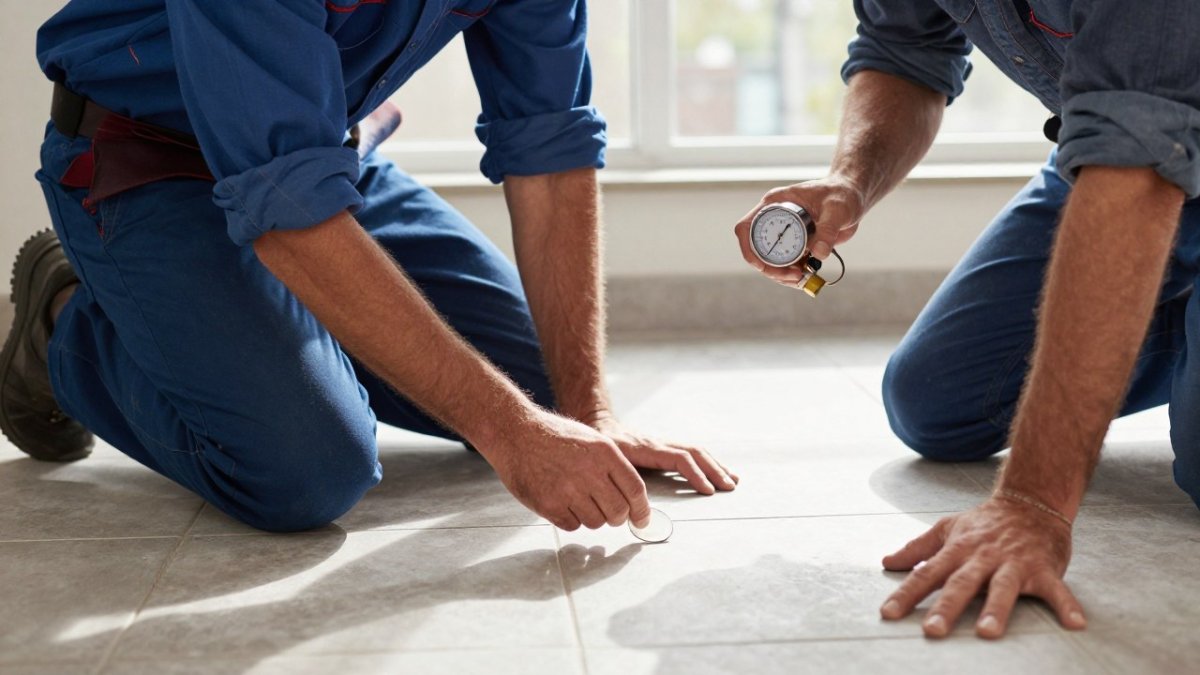
Direct access repair means jackhammering through the concrete slab, removing the damaged section of pipe, and patching the floor afterward. It is the oldest method and still the most straightforward for a single, clearly located leak.
The advantages are real: the repair is verifiable, the failed pipe is fully replaced, and the technique suits shallow lines. The drawbacks are equally real. Concrete removal, excavation, and floor restoration add cost and downtime, and finished flooring rarely matches afterward. This method also makes little sense when the leak sits under cabinetry or a load-bearing wall.
Watch out: cutting concrete without confirming the leak location first is how homeowners end up with two holes in the floor and one leak still running.
Tunneling Beneath the Foundation: Repair Without Breaking the Floor
Under-slab tunneling creates a small access pit outside the foundation and a crawl space beneath the slab, letting a plumber reach the pipe without touching your flooring. It costs more in labor hours but preserves tile, hardwood, and cabinetry.
Tunneling is often considered when the leak sits under a finished interior floor and direct access would destroy it. The trade-off is time and excavation risk near footings, which is why foundation stability has to be assessed before anyone digs.
Pipe Rerouting for Slab Leaks: When Bypassing the Damaged Line Wins
Pipe rerouting abandons the damaged line in place and runs a new bypass line through the attic, walls, or ceiling. For repeated failures in an aging under-slab system, rerouting can sometimes be preferable to repairing the same pipe twice, because it replaces the failure-prone path rather than chasing leaks through concrete.
A reroute begins at the water heater or main shutoff, travels up through a wall cavity or attic chase, and drops down to serve each fixture from above. That path determines everything: how much drywall gets opened, whether the attic has clearance for insulated lines, and whether the new run can reach a distant bathroom without crossing a load-bearing beam. In cold climates, attic runs need freeze protection, which is a real constraint in northern states.
Pipe material is the first filter. Copper that has failed once under a slab is often failing because of aggressive soil, abrasive contact with concrete, or a recirculation system that wears the pipe from the inside. In those cases, a spot repair fixes one pinhole while the rest of the line keeps thinning.
Leak extent is the second filter. A single isolated pinhole on a short, accessible run may justify a direct repair. But when detection finds multiple pressure losses on the same line, when the leak sits under a finished floor that would be destroyed by access, or when the line runs beneath a post-tension slab where cutting is restricted, rerouting moves to the front of the list.
Rerouting is not a universal answer. It fails when the new path cannot reach the fixture without major structural work, when the home has no attic or wall cavity large enough for insulated lines, or when the existing system is so degraded that the bypass simply shifts the failure to the next segment. If the assessment points to a system-wide problem rather than one leak, repiping may be the better long-term answer, .
Watch out: approving a reroute before a full pressure test of every branch is how homeowners end up paying for a bypass while a second failing line keeps leaking under the same slab.
Trenchless Repair: Pipe Lining and Epoxy Coating Without Excavation
Trenchless repair rehabilitates the existing pipe from the inside, using pipe lining or epoxy pipe coating to seal cracks without excavation. It can be fast and clean and preserves the slab, but it only works when the host pipe is still worth saving.
Cured-in-place pipe lining works like this: a flexible liner saturated with resin is pulled or inverted into the damaged section, inflated against the pipe wall, and cured in place with heat or ambient air. The result is a new jointless interior wall that seals cracks and spans small gaps.
The host pipe is the gatekeeper. Lining requires a pipe that is still structurally sound, correctly sized, and free of major offsets or collapses, a line that has lost its shape cannot hold a liner against the wall. Coating requires a clean, dry, continuous interior; scale, heavy corrosion, or standing water prevents the epoxy from bonding.
Diameter loss is the trade-off homeowners rarely hear about. A liner consumes roughly a quarter to a third of the internal diameter depending on wall thickness, which matters on older narrow lines already serving multiple fixtures. Coating consumes far less, but it also provides less structural support.
Durability varies by process and installation quality. A properly installed liner can last decades, but its life depends on the resin, the cure, and the condition of the host pipe it bonds to. Coating is thinner and more sensitive to surface preparation; a poorly cleaned line is where coating failures start.
Trenchless methods also have a narrower scope than the marketing suggests. They are best suited to supply lines with isolated pinholes, joint failures, or internal corrosion, not to drain lines with root intrusion or bellied sections, and not to systems where multiple branches are failing at once. When detection shows a single compromised segment on an otherwise sound line, lining or coating can be the least disruptive option on the table.
Watch out: accepting a trenchless quote without a camera inspection and a pressure test of the host pipe is how homeowners pay for a liner that cannot bond or a coating that fails within a year.
Slab Leak Repair Cost: What Drives the Price of Each Method
Slab leak repair cost depends on four variables: leak location, pipe material, access difficulty, and the restoration work that follows. No honest plumber quotes a number before detection, because the method drives the price far more than the leak itself.
Published cost guides put detection at roughly $150 to $600, minor spot repairs at $500 to $1,500, and rerouting or repiping anywhere from $1,500 to $15,000 depending on scope, according to Horizon Services’ comparison of slab leak repair options. Angi’s slab leak cost guide notes that targeted waterproofing of a small area can run around $200, which is a different job from a full pipe repair. Treat every figure as a range, not a quote.
Published cost ranges for slab leak detection, spot repairs, and rerouting
Does Homeowners Insurance Cover Slab Leak Repair?
Homeowners insurance usually covers the resulting water damage, not the pipe repair itself. Most policies treat the failed pipe as a maintenance item and exclude it, while covering torn-out walls, ruined flooring, and mitigation.
Coverage depends on the policy and the cause of the leak. Sudden versus gradual damage is the dividing line adjusters use. Document everything, photograph the damage, and keep the failed pipe section. If water is actively spreading, reach an emergency plumber first and sort the claim afterward; mitigation limits the loss either way.
The hardest part of a slab leak is not the repair. It is choosing the right method before anyone breaks concrete. At Protek Plumbing and Drain Specialists, we aim to locate the leak first and provide a transparent estimate before work begins. Our licensed, bonded, and insured team stands behind its work with a 100% workmanship guarantee, and we offer 24-hour emergency service. Contact Protek Plumbing and Drain Specialists to fix the leak once, with the method that actually fits your foundation.
Frequently Asked Questions
What is the most effective way to fix a slab leak?
There is no single best method for every home. Direct access repair is the most straightforward when the leak is in one accessible spot and the flooring can be restored. Tunneling limits floor damage but requires specialized crews. Pipe rerouting for slab leaks makes sense when the damaged line is one of several and can be bypassed. Trenchless lining works when the pipe is still structurally sound enough to hold a liner. A licensed plumber should confirm the leak location and pipe condition before recommending a method.
Can you fix a slab leak without breaking through the concrete?
Yes, in some cases. Tunneling, pipe rerouting, and trenchless lining all avoid breaking up the main floor slab. Tunneling digs under the foundation from the outside to reach the pipe. Rerouting runs a new line through walls or the attic. Trenchless methods insert a liner or epoxy coating inside the existing pipe through small access points. Each option depends on the leak’s location, the pipe material, and how much of the line is damaged, so an on-site evaluation comes first.
Does homeowners insurance cover slab leak repair?
Coverage depends on the cause and your policy. Most homeowners policies cover sudden, accidental water damage, such as a pipe that burst and soaked flooring or drywall. They often exclude the cost of repairing the pipe itself and any damage caused by long-term leakage or lack of maintenance. Some policies cover access and tear-out costs. Review your policy’s water damage and foundation sections, document the damage with photos, and ask your adjuster before authorizing work.
How long does slab leak repair take?
Timelines vary by method and by the specifics of each leak. Ask for a written schedule before work starts, and confirm who handles concrete, drywall, and flooring restoration.
