
Table of Contents
- What Is a Slab Leak and Why It Demands Immediate Action
- Slab Leak Detection Cost and Methods That Work
- Trenchless Slab Leak Repair Methods: Minimally Invasive Solutions
- How to Mitigate Water Damage After a Slab Leak Discovery
- 24/7 Emergency Slab Leak Repair: What to Expect
- Insurance Claims and Coverage for Slab Leak Repairs
- Long-Term Foundation Maintenance to Prevent Future Leaks
- Frequently Asked Questions
Last Updated: September 21, 2026
What Is a Slab Leak and Why It Demands Immediate Action
A slab leak occurs when water pipes running beneath your home’s concrete foundation develop cracks or holes, allowing water to escape into the soil below. These hidden leaks can cause serious foundation damage, mold growth, and structural failure if left unaddressed. At Protek Plumbing and Drain Specialists, we understand that the longer you wait, the worse the damage becomes.
What makes slab leaks particularly dangerous is their invisibility. Unlike a burst pipe under your sink, you won’t see water pooling in your basement. Instead, you’ll notice warning signs: an unexplained spike in your water bill, warm spots on your floor, or the faint sound of running water when all fixtures are off. By the time most homeowners call for help, the leak has already compromised the structural integrity of their foundation.
The cost of ignoring a slab leak compounds quickly. Water pooling beneath your foundation creates hydrostatic pressure that weakens concrete and shifts the foundation itself. This pressure can crack walls, buckle floors, and destabilize entire sections of your home. Emergency repair becomes exponentially more expensive once foundation damage sets in.
Signs Your Foundation May Have a Hidden Leak
Catching a slab leak early makes the difference between a manageable repair and a foundation replacement. Watch for these specific warning signs that indicate you need professional slab leak detection immediately.
An unusually high water bill is often the first clue. If your usage hasn’t changed but your bill jumped 20-30% or more, water is escaping somewhere in your system. Check your water meter: turn off every fixture in your home, then watch the meter dial. If it continues moving, you have an active leak.
Warm spots on your floor reveal leaks in hot water lines specifically. Walk across your floors barefoot, especially in hallways and living areas. If you feel a patch of warmth that doesn’t correspond to sunlight or heating vents, that’s likely a hot water line leaking beneath the slab.
Damp flooring, soft carpets, or visible mold growth indicate water saturation beneath your home. Moisture rising through the concrete creates ideal conditions for mold, which poses health risks and accelerates structural decay. If you notice musty odors alongside these signs, professional evaluation is urgent.
Listen carefully in quiet moments. A faint hissing or trickling sound when all water fixtures are off suggests active water movement beneath the foundation. This sound often comes from water pressure forcing water through a crack in a sub-slab plumbing line.
Slab Leak Detection Cost and Methods That Work
Professional slab leak detection uses specialized equipment to pinpoint the exact location of leaks without unnecessary excavation. The cost of detection typically depends on your home’s size and the complexity of your plumbing system, but early detection can save significant foundation repair expenses. Contact Protek Plumbing and Drain Specialists for a transparent estimate specific to your situation.
The most common detection methods balance accuracy with cost-effectiveness. Electronic leak detection equipment sends signals through your water lines to identify breaks. Thermal imaging cameras detect temperature variations that reveal hot water leaks. Water meter testing confirms whether a leak exists before investing in detection technology. Pressure diagnostics measure system integrity and isolate problem areas.
Electronic Leak Detection and Thermal Imaging
Electronic leak detection works by transmitting a signal through your water supply lines. When the signal reaches a crack or hole, it escapes and can be detected above ground using specialized equipment. A technician traces the strongest signal to pinpoint the leak’s location within a few feet. This method works reliably for pressurized water lines.
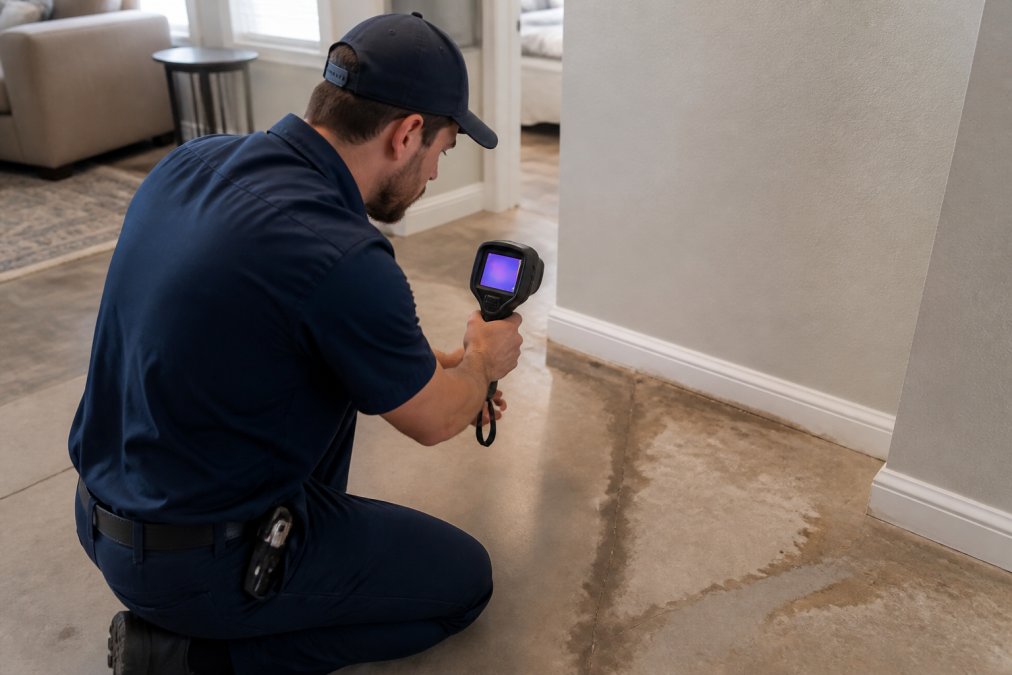
Thermal imaging cameras detect temperature differences in your concrete slab. Hot water leaks create warm spots on your floor’s surface that show up clearly on thermal images. This non-invasive method works best for recently active leaks and provides visual documentation of the problem area. Many emergency plumbing services use thermal imaging as a first diagnostic step.
Water Meter Testing and Pressure Diagnostics
Water meter testing is the simplest first step. Turn off all water-using appliances and fixtures, then observe your meter for 10-15 minutes. If the meter dial moves, you have an active leak. This test takes minutes, making it a logical starting point before calling a professional.
Pressure diagnostics measure the integrity of your entire plumbing system. Technicians isolate different sections of your water lines and test pressure retention. A section that loses pressure indicates a leak in that line. This method narrows down which part of your sub-slab plumbing requires attention, reducing the need for extensive excavation.
Call Now For A Free Estimate ?
Trenchless Slab Leak Repair Methods: Minimally Invasive Solutions
Modern emergency slab leak repair prioritizes minimally invasive techniques that avoid tearing up your entire foundation. Trenchless repair methods seal or replace damaged pipes without excavation, preserving your concrete and landscaping while reducing repair time and cost.
The most effective minimally invasive approach depends on the pipe material, leak severity, and your home’s age. Older homes with corroded pipes may benefit from full re-piping, while newer homes with isolated leaks often respond well to pipe lining. A qualified technician assesses your specific situation and recommends the approach that balances cost, durability, and disruption.
Epoxy Pipe Lining and Re-Piping Options
Epoxy pipe lining seals the interior of damaged pipes without removing them. A flexible tube coated with epoxy resin is inserted into the damaged line, then inflated to press the coating against the pipe walls. The epoxy hardens, creating a new pipe inside the old one. This method works for pinhole leaks and minor corrosion and preserves your concrete slab intact.
Re-piping involves replacing the damaged section of pipe with new material. For slab leaks, this typically means running new copper or PEX lines above ground or through walls, bypassing the damaged sub-slab section entirely.
If your home was built before 1980, your original copper or galvanized steel lines may be corroded throughout the system. A single slab leak often signals that other leaks will follow. Ask your technician whether whole-house re-piping makes financial sense long-term compared to repeated emergency repairs.
How to Mitigate Water Damage After a Slab Leak Discovery
Once a slab leak is confirmed, water damage mitigation begins immediately. The longer water sits beneath your foundation, the more damage occurs to concrete, soil, and structural supports. Professional mitigation involves extracting standing water, assessing damage, and preventing mold growth.
Never ignore water pooling beneath your home after a slab leak repair. Residual moisture creates mold and ongoing foundation stress. If your home still feels damp 48 hours after repair, contact your plumber immediately, the leak may not be fully sealed or a secondary leak may exist.
24/7 Emergency Slab Leak Repair: What to Expect
When you call Protek Plumbing and Drain Specialists for emergency slab leak repair services, our team responds with urgency and professionalism. We understand that a slab leak threatens your home’s foundation and your family’s health. Our commitment is rapid diagnosis, transparent communication, and effective repair.
Same-Day Service and Rapid Response Times
Same-day repair is possible for many slab leaks when detection and repair methods align. Epoxy pipe lining can often be completed once the leak is located. Re-piping above the slab may take longer for isolated sections. Our team coordinates with you to minimize disruption while prioritizing the repair’s speed and quality.
Insurance Claims and Coverage for Slab Leak Repairs
Homeowners insurance coverage for slab leak repairs varies significantly based on your policy, the cause of the leak, and your insurer’s specific language. Most standard policies do not cover routine maintenance or gradual deterioration, but sudden leaks caused by plumbing failures may qualify for coverage. Review your policy’s water damage section or contact your agent before assuming you’re responsible for the full repair cost.
Insurance rarely covers slab leak repairs completely, but it often covers a significant portion. The key is prompt notification and thorough documentation. Delaying your claim or skipping the professional diagnosis step often results in claim denial.
Long-Term Foundation Maintenance to Prevent Future Leaks
Preventing future slab leaks requires attention to your plumbing system’s health and your home’s foundation environment. Regular maintenance catches problems before they become emergencies, and smart practices reduce the risk of new leaks developing.
| Slab Leak Detection Method | Speed | Cost Range | Best For |
|---|---|---|---|
| Water meter testing | 15 minutes | Free | Confirming leak presence |
| Electronic leak detection | 1-2 hours | Moderate | Pinpointing exact location |
| Thermal imaging | 30-60 minutes | Moderate | Hot water line leaks |
| Pressure diagnostics | 1-2 hours | Moderate | Isolating problem sections |
Frequently Asked Questions
What are the early warning signs of a slab leak?
Watch for unexplained spikes in your water bill, warm spots on your floor, damp carpeting, mold growth in unexpected areas, and the sound of running water when no fixtures are in use. Foundation cracks and shifting doors or windows can also indicate hydrostatic pressure from water beneath your slab. If you notice any combination of these signs, contact a professional for slab leak detection immediately to prevent structural damage.
Can you fix a slab leak without digging?
Yes. Trenchless slab leak repair methods like epoxy pipe lining and re-piping allow technicians to repair leaks without excavating your foundation. These minimally invasive techniques seal or replace damaged pipes from inside, protecting your concrete slab and reducing repair time. However, not every slab leak is suitable for trenchless repair, your plumber will assess the leak location and pipe condition to determine the best method for your situation.
Will homeowners insurance cover a slab leak?
Coverage depends on your policy and the cause of the leak. Sudden, accidental leaks from burst pipes may be covered, but gradual leaks from pipe corrosion typically are not. Damage from water that has already escaped (like mold or foundation damage) is often excluded. Review your policy details and contact your insurer immediately after discovering a slab leak. Document everything with photos and professional inspection reports to support any claim you file.
How quickly can emergency slab leak repair services respond?
Professional emergency plumbing services operate 24/7 and typically arrive within 60-90 minutes of your call. Fast response is critical because every hour a slab leak continues, water damage worsens and structural integrity deteriorates. When you call, be ready to describe your symptoms, unexplained water bills, warm spots, or visible moisture, so the dispatcher can prioritize your emergency and dispatch the right equipment and technician.